Large Swedish organisation · 2021–2025
Intranet for a large organisation
How do you build an intranet that works at launch and can keep evolving as the organisation's needs change?
AreasUser interviews · Information architecture · UX/UI · Prototyping · Sitevision · Iterative development
This project is based on a real assignment. The client’s identity and the material have been anonymised or simplified for confidentiality.
Images and working material are presented in an adapted form to explain the approach and design decisions.
About the client
A large Swedish organisation with employees across different parts of the business. The intranet brings together information and support they need in their everyday work.
The problem to address
Content and navigation needed to reflect how employees actually searched for and used information. The work began with an initial design in 2021 and continued over several years, with new needs and further development leading to version 3.0.
Understand the problem
How do employees find what they need when information belongs to several parts of the organisation?
I created the first intranet design in 2021. Employees from different parts of the organisation were interviewed about their everyday work, information needs and problems with the existing intranet. The research informed both content priorities and information architecture.
This provided a starting point for the content and structure.
Insights
The structure needed to reflect how employees search for and use information.
Interviews with different employee groups revealed their everyday work, needs and problems with the existing intranet.An intranet needs to evolve over time.
The initial design was created in 2021. After several years of use and further development, version 3.0 launched in 2025.Employees' information needs and the ability to develop the intranet over time became two starting points for the work.
Key decisions
Use interviews and identified needs as the basis for the new information structure.
A new visual interface would not have solved the underlying problem if information was still organised in a way that did not work for employees.
Design within Sitevision's actual constraints.
The design was based on Sitevision's available templates and components. I worked with the CMS's possibilities and limitations to develop a feasible solution. My knowledge of Sitevision, where I am a certified Sitevision Web Developer, supported that work.
The next step was to make the structure concrete in a wireframe.
From information structure to wireframe
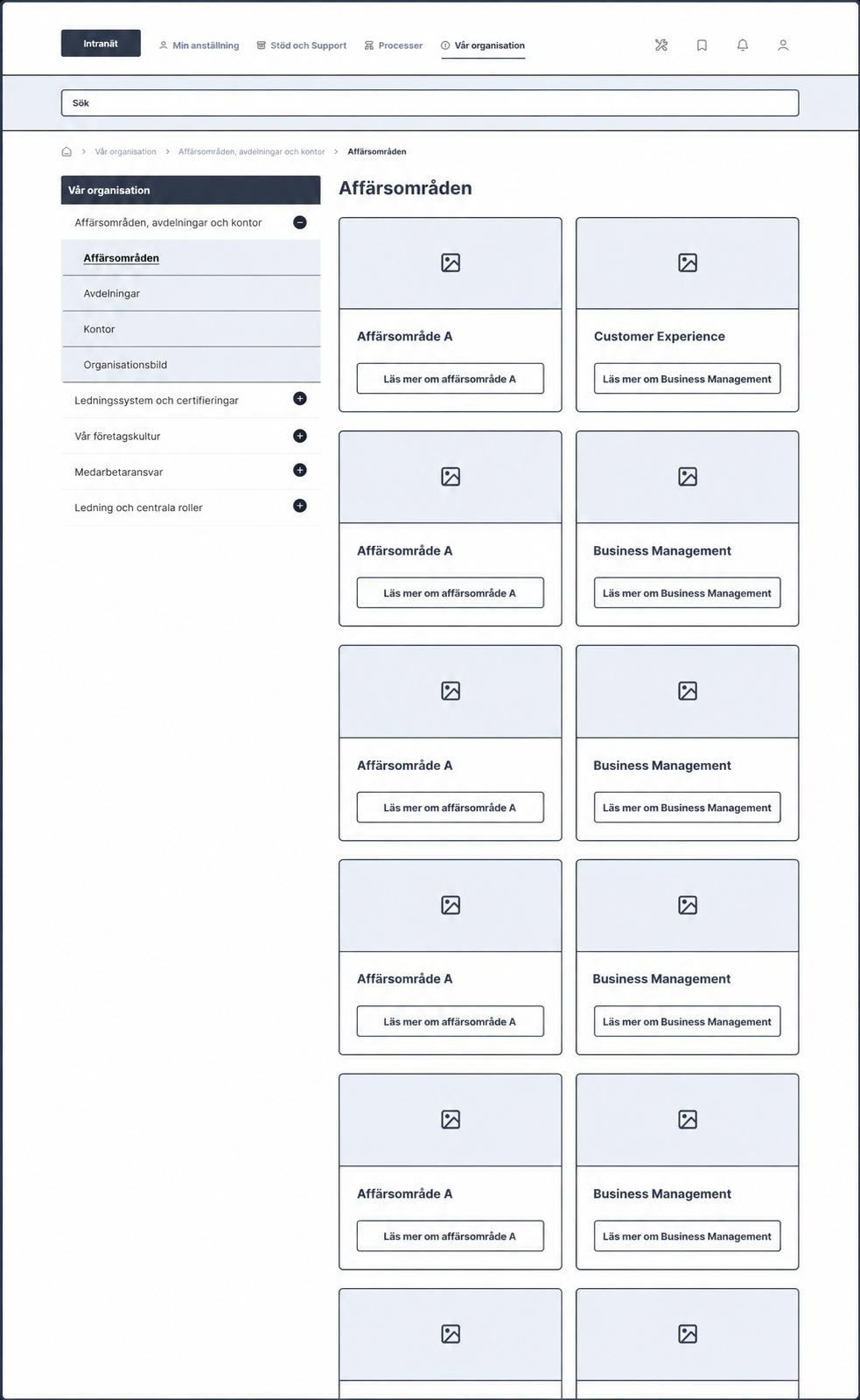
The intranet wireframe shows how the information structure becomes an actual page. I needed to connect the main navigation, local menu and page content.
Where am I, and what is here?
Breadcrumbs show the path to the page. The left-hand menu shows related content and highlights the current page. In the main area, business units share a consistent structure so the next step is recognisable.
Structure before detail
At this stage, images and names are placeholders. The focus is on content order, hierarchy and navigation. This makes it possible to discuss how the page works before the visual design is finished.
But the first version was only the beginning.
Development over time
First version
Employee research, information structure and the initial design.
Ongoing development
The product continued to evolve as new needs and opportunities for improvement were identified.
Version 3.0
A major update to the intranet launched after several years of real use.
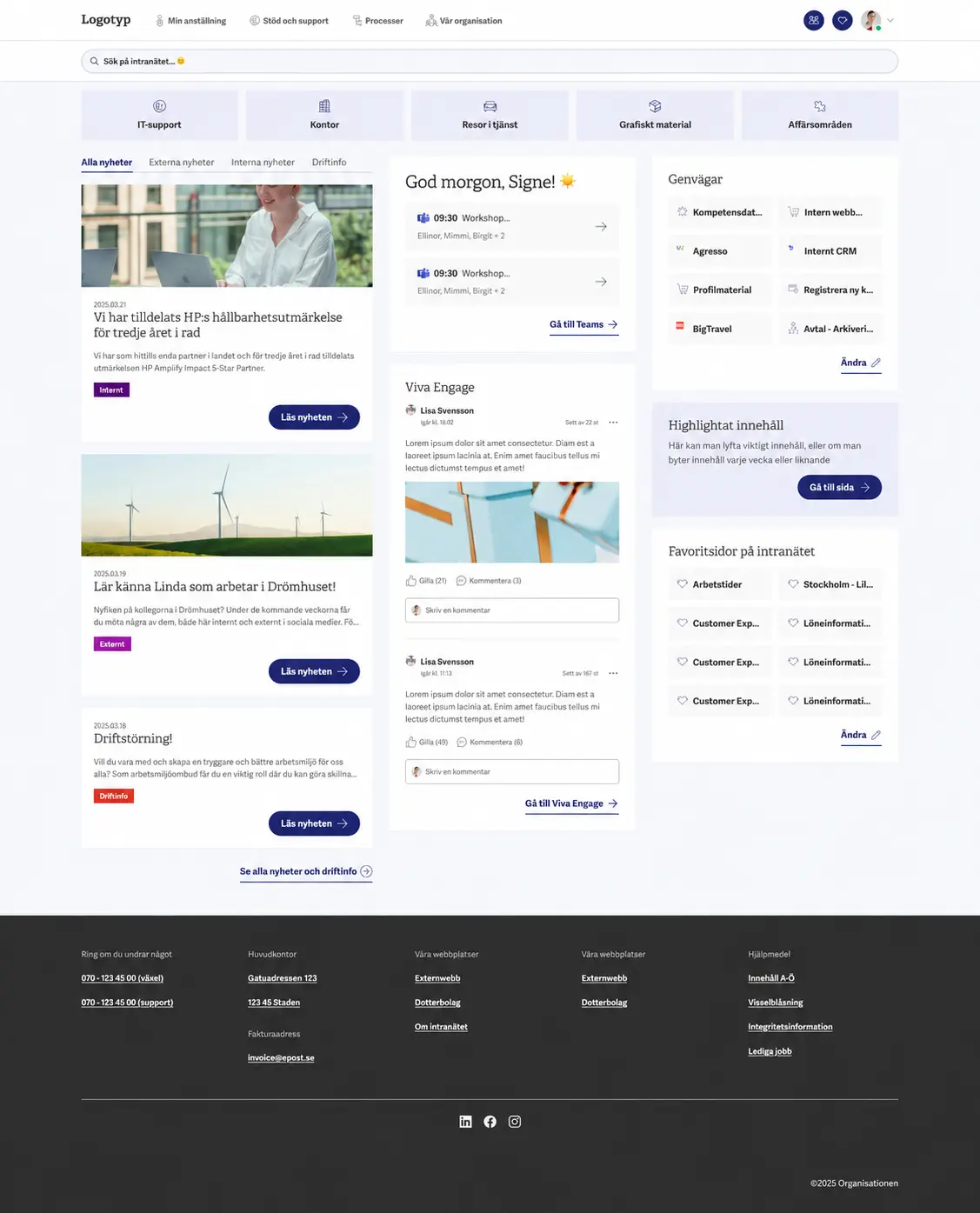
The intranet evolved from its initial design in 2021 to version 3.0 in 2025.
Reflection
Following the same product over several years has changed how I think about digital services. A launch is not the end of UX work.
Real use reveals things that cannot be fully anticipated before launch. Those insights need to inform the product's continued development.